

AI + UX = Better Conversions? Here’s How It’s Happening
Have you ever found yourself on a site that appeared to be reading your mind? It had shown you what you wanted before you could even think about what to do next.
Or you might have used an app so smooth and easy that you didn’t need to pause or think about anything. It almost felt like someone had secretly set things up just for you. How do they do that? What goes on behind the scenes that makes these experiences so effortless?
The answer lies in two strong forces that determine the future of digital experiences: User Experience and Artificial Intelligence. AI is no longer a far-off concept from science fiction. It sits rather quietly behind the scenes of various tools we use almost daily, functioning like a knowledgeable assistant that listens, learns, and anticipates. Machine learning identifies patterns from vast amounts of information to predict what other users are most likely to do next.
Natural Language Processing enables AI to speak in a natural manner, such as a chatbot immediately responding to your inquiry. Predictive Analytics assists businesses by allowing companies to anticipate behavior and take action before issues arise. IDC estimates that by 2026, global spending on AI systems will exceed $300 billion as more companies utilize it to make informed decisions and enhance customer experiences.
On the other hand, UX focuses on people. It is no longer merely about making websites user-friendly. Now, UX takes into account the entire journey, from the very first click to the final interaction. It is the experience that the users have when they navigate through it, whether all the steps make sense and whether they are satisfied with the experience. This is to eliminate friction and naturalize the flow of everything. Forrester discovered that firms investing in UX can recoup up to 100 times their investment, demonstrating how valuable experiences can drive real growth.
Something exciting happens when AI and UX are combined. AI brings a profound understanding of what is desired by users and UX transforms those desires into experiences that people enjoy. It is like combining the brain and the heart of a digital experience, and it is quietly transforming the way businesses attract, engage, and convert users.
In this blog, we will explore how this partnership comes to life, examine actual examples of companies at the forefront, and discuss how you can incorporate these concepts into your own plan.
Read: How Integrated Billing and Claim Management Transform Clinic Workflows
How AI and UX Work Together
Now that we’ve explored how AI brings intelligence and UX emphasizes people, it’s time to see what happens when these two forces come together. This is where it gets exciting. Both are great on their own, but when combined, they create experiences that almost seem alive, adapting in real time according to the desires of users.
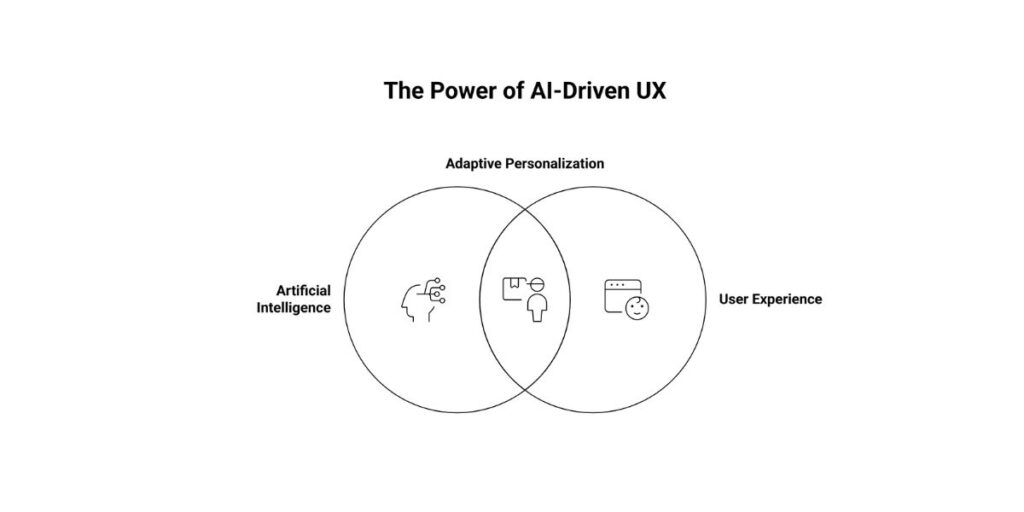
AI is the analytical mind of a digital experience. It analyzes enormous volumes of data, identifies trends that would otherwise have been invisible to humans, and anticipates user behavior. It transforms the guesswork into cues, enabling businesses to know what is intended and approach each person in their own way. Consider it as the backstage spectator who learns something every time it interacts.
UX is the hand that directs all of this smartness to the user. It makes sure that information discovered by AI is represented in a manner that is natural, empathetic and easy to follow. Even the brightest AI would be cold and confusing without UX. It makes the experience friendly and easy, as in the examples we imagined about websites that we believed were reading our minds.
The most remarkable aspect of this combination is the shift from reacting to predicting. Formerly, UX was dependent on research and feedback to enhance experiences over time. Designers would research user behavior, implement changes and wait till the results appear. Under AI, this process occurs immediately. Experiences are no longer fixed. They are real-time and vary according to what each user is doing, and what they may do subsequently. It is as though it is the transition between observing the past and creating the present.
Consider a situation where you enter a library and everyone looks at the same display of books. That is the way most traditional websites operate. Imagine now a personal librarian who restacks the shelves each time you walk in, and sets exactly what you’re interested in right in front of your face. That is what occurs when AI and UX collaborate. The experience is personal, considerate, and nearly effortless.
Turning AI + UX Into Better Conversions
In the above section, we explored the collaboration between AI and UX to deliver a personalized and adaptive experience. Now we shall see how this combination becomes actual results. Here is where clever design takes tangible effect, and businesses begin to achieve legitimate growth.
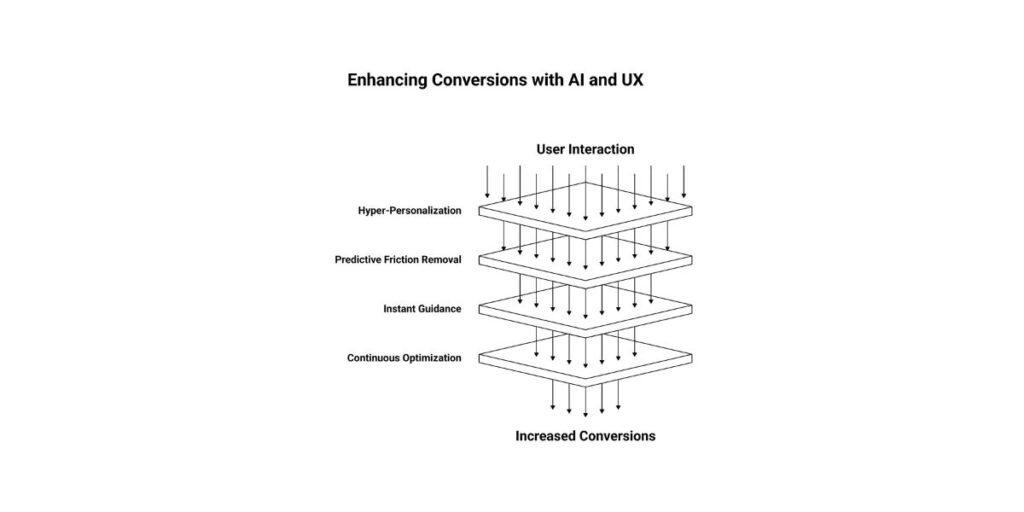
- Hyper-Personalization at Scale
Hyper-personalization is one of the most powerful products of this collaboration. Previously, we discussed the way AI can discern patterns and predict behavior. This enables companies to dynamically personalize content, suggestions, and products for each visitor. McKinsey discovered that personalization can boost revenues up to fifteen percent and make marketing expenditure more efficient. Users remain, browse and take action when they feel that the experience is made for them. - Predictive Friction Removal
Another mechanism through which AI and UX increase conversions is by eliminating friction before it can be detected. Consider an intelligent search that completes what you are about to write or a timely offer that comes up when one intends to leave a page. With the ability to anticipate behavior, AI facilitates the path and rescues users who may have lost track. - Instant, Intelligent Guidance
Immediate directions are equally significant. Many visitors leave due to being stuck or having questions. AI-based chatbots intervene at the appropriate time providing practical assistance and directing users in the correct direction. IBM discovered that conversational AI can lower the support costs and enhance conversions by maintaining engagement and tracking. - Continuous, Automated Optimization
The last mechanism is constant improvement. The traditional method of enhancing conversions involved performing one test at a time and waiting for the outcome. AI can test thousands of variations simultaneously and learn about user behavior in the moment. Organizations that optimize their processes with AI typically achieve double-digit gains compared to companies that only employ manual testing.
How Leading Brands Are Using It
By this time, you are probably asking yourself what all of this would be like in the real world. Discussing AI and UX as a collaborative effort is one thing, and witnessing it in action is another. The good news is that even some of the most well-known brands are already leveraging this powerful mix to create experiences that we engage with daily, without even having to think about it.
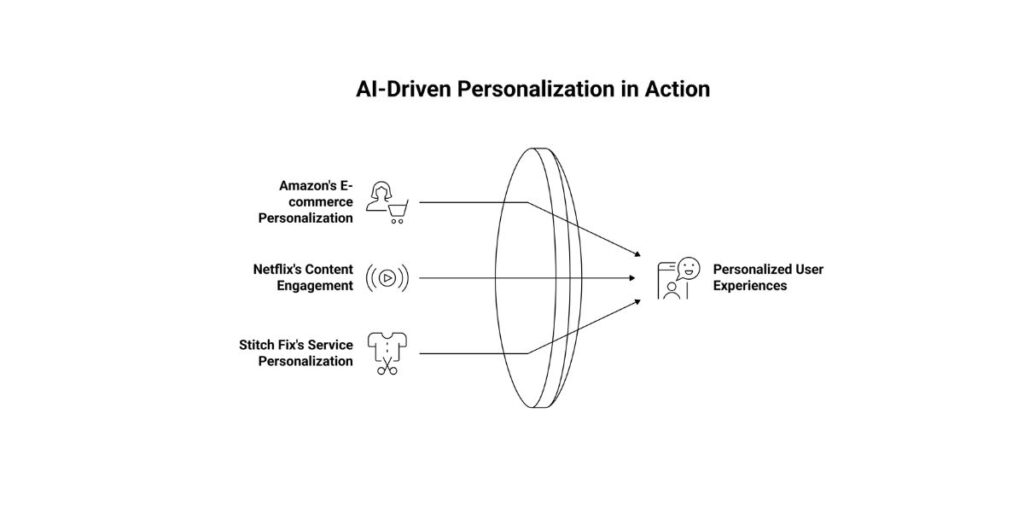
- Amazon (E-commerce Personalization)
Amazon is a prime example. Its recommendation engine analyzes the browsing history, past purchases, and the behavior of similar users, then suggests what the consumer might like next. The intelligence works quietly in the background, leaving the experience effortless. This scheme accounts for approximately thirty-five percent of Amazon’s total sales, demonstrating the effectiveness of personalization. - Netflix (Content Engagement)
Netflix has inserted this idea into its content. Its AI assesses viewing habits and customizes everything from recommendations to the artwork displayed on-screen. By the time users log in, it feels like the platform knows their taste. This deep personalization influences approximately 80% of the audience’s content consumption, demonstrating how predictive experiences enhance engagement. - Stitch Fix (Service Personalization)
Stitch Fix introduces another twist by combining AI with human creativity. The platform analyzes feedback, preferences, and photos using algorithms, and stylists refine these decisions to generate more personalized selections. This combination of data and human touch has created a robust subscription model that has retained customers.
These companies utilize the same principles that we discussed above. AI offers a perception of insight, the UX makes the experience look and feel natural, and the two create journeys that seem personalized to an individual.
How to Bring AI + UX Into Your Business
Having observed how large enterprises utilize AI and UX to create intense experiences, the question that now emerges is how to apply this to your business. It may appear complicated at first, but it becomes easy with a clear plan. The trick to it is to take targeted actions that convert our ideas into tangible results.
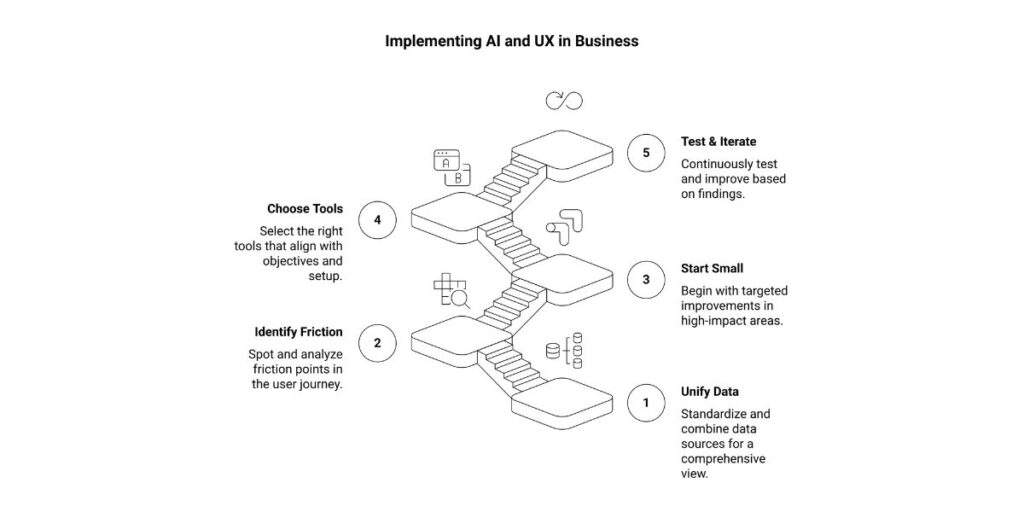
Step 1: Unify Your Data:
The initial step is to standardize your data. To be effective, AI requires precise and linked data. Combine all sources of data to have the whole picture of your customers. This provides AI with the base through which it can offer insights that UX can transform into superior experiences.
Step 2: Identify Key Friction Points:
Next, spot the friction points within the user’s journey. Observe where they are dropping off or losing interest and let those moments serve as points of reference for improvements through AI. Even minor improvements, such as more intelligent search or timely help make a step in the right direction.
Step 3: Start Small and Scale:
When you understand where to focus, begin small and gradually grow. Select one impact area with high impact, e.g., the enhancement of site search or the introduction of a helpful chatbot. The little victories create momentum and provide valuable lessons for the next steps.
Step 4: Choose the Right Tools:
Then, choose the right tools. A web personalization platform, customer data solutions, and AI testing tools can be helpful, but the most suitable option is the one that aligns with your objectives and existing setup. An effective tool must facilitate the ease with which one can connect data, personalize experiences and quantify outcomes.
Step 5: Test, Learn, Iterate
Lastly, consider it a continuous process. Similar to the case of constant optimization as we mentioned, AI and UX are most effective when they continue to learn and change. Continuously test, improve based on the findings and gradually increase the experience.
With these steps, you will begin to create experiences that are as smooth and intelligent as those developed by top firms. It begins with simple, targeted actions that unlock the potential of AI and UX in collaboration.
Author’s Bio:
Vidhatanand is the Founder and CEO of Fragmatic, a web personalization platform for B2B businesses. He specializes in advancing AI-driven personalization and is passionate about creating technologies that help businesses deliver meaningful digital experiences.